A clutch rarely fails without warning. Most drivers notice something first: the engine revs climbing without the car picking up speed, a pedal that feels different, a grinding gear change or a burning smell after a hill start. This guide explains what those signs usually mean, what clutch replacement involves, what affects the cost, and when it’s worth getting your car looked at by a garage.
It’s written for drivers of manual cars in and around West Bromwich and the wider West Midlands. The advice applies to most makes and models, although every car is slightly different.
What does a clutch actually do?
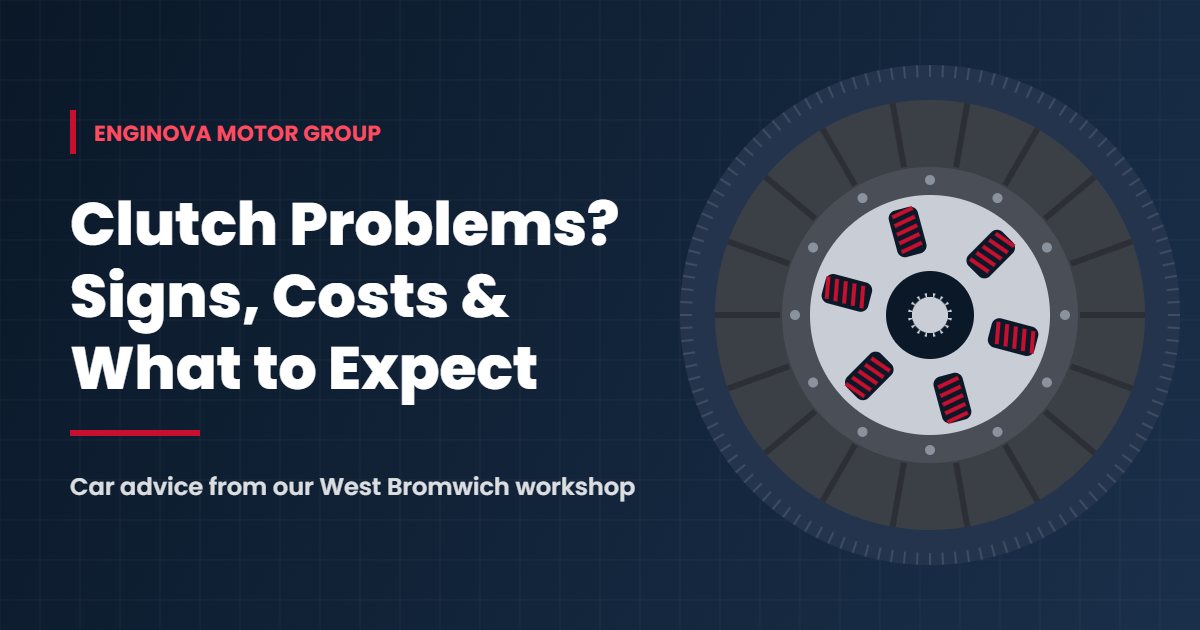
The clutch connects and disconnects the engine from the gearbox. When your foot is off the pedal, a spring-loaded pressure plate clamps a friction disc against the engine’s flywheel, so the engine’s power turns the gearbox and the wheels. When you press the pedal, that clamping force is released, the engine and gearbox separate, and you can change gear or stop without stalling.
The friction disc works a bit like a brake pad: it wears a little every time the clutch is engaged, especially when it slips while you pull away. Eventually there isn’t enough friction material left to grip properly, and that’s when most of the symptoms below start to appear.
A typical clutch system is made up of:
- Friction disc (clutch plate) – the part that wears out
- Pressure plate – clamps the disc against the flywheel
- Release (thrust) bearing – presses on the pressure plate when you push the pedal
- Flywheel – either a solid single-mass flywheel or a dual-mass flywheel (DMF) on many modern diesels and some petrol cars
- Operating system – a cable, or more commonly a hydraulic master and slave cylinder
Common signs of a failing clutch
1. The clutch is slipping
A slipping clutch is the classic sign of a worn clutch. You press the accelerator, the revs rise, but the car doesn’t speed up to match. It’s usually most obvious in higher gears, when accelerating hard, climbing a hill, overtaking or carrying a heavy load. At first it might only happen now and then, but it normally gets worse over time.
2. Difficulty changing gear
If gears crunch or grind, or first and reverse are hard to select when the car is stationary, the clutch may not be disengaging fully. This can be caused by a worn clutch, but it’s also common with hydraulic problems, a stretched or badly adjusted cable, or a gearbox fault.
3. The clutch pedal feels different
You get used to how your clutch pedal feels, so changes are worth noticing:
- Higher bite point – the car only starts to move right at the top of the pedal’s travel, which often happens as the clutch wears.
- Spongy or soft pedal – often points to air in the hydraulic system or a leaking master or slave cylinder.
- Heavy or stiff pedal – can be a sticking cable, a worn release mechanism or a tired pressure plate.
- Pedal sticks to the floor or doesn’t return – usually a hydraulic fault, and one that can leave you unable to change gear.
4. Unusual noises
A whirring, squealing or chirping noise that appears or changes when you press the clutch pedal often points to a worn release bearing. A rattle or knock at idle that goes away when you press the pedal can come from the gearbox input bearings or, on cars with one, a worn dual-mass flywheel. Noises are hard to pin down by ear alone, so they’re worth having checked properly.
5. A burning smell
An acrid smell, a bit like burning paper or hot brakes, is overheated friction material. One tricky hill start or a lot of stop-start traffic can cause it now and then. If the smell keeps coming back, or appears alongside slipping, the clutch is likely wearing quickly.
6. Judder or vibration when pulling away
If the car shudders as the clutch bites, the cause could be a contaminated or glazed clutch disc, an uneven pressure plate, a worn dual-mass flywheel or even worn engine and gearbox mounts.
Noticed any of these signs?
Clutch problems rarely fix themselves. Our West Bromwich workshop can check the clutch, flywheel and hydraulics and tell you what’s actually wrong before you spend money on parts.
Book a clutch inspectionCall 07407 722894How to tell whether your clutch may need replacing
You don’t need to test your car hard to spot a problem. Everyday driving usually tells you enough. Pay attention to:
- whether the revs flare without the car accelerating, especially in 4th or 5th gear
- where the bite point sits, and whether it has crept higher
- how easily first and reverse go in when you’re stopped
- any new noises that change when you press or release the pedal
- any smell after pulling away, reversing up a slope or parking on a hill
Many of these symptoms overlap with other faults, so the table below is a guide rather than a diagnosis.
| Symptom | Common causes | Always the clutch? |
|---|---|---|
| Revs rise, car doesn’t accelerate | Worn friction disc, oil contamination, weak pressure plate | Usually clutch-related, but an oil leak may need fixing too |
| Crunching or hard gear changes | Clutch not disengaging, hydraulic fault, cable, gearbox wear | No, hydraulics and gearbox faults are common |
| Spongy pedal or pedal on the floor | Air or leak in the hydraulic system, failed master or slave cylinder | Often the hydraulics rather than the clutch itself |
| Noise when pressing the pedal | Worn release bearing | Usually replaced as part of a clutch kit |
| Rattle at idle, judder pulling away | Dual-mass flywheel, clutch disc, engine or gearbox mounts | Not always, so it needs inspecting |
What happens if you keep driving with a failing clutch?
A slipping clutch doesn’t usually fail all at once, which is why many people keep driving on it. The risks are real, though:
- It gets worse. Slipping creates heat, and heat wears the friction material faster.
- More parts can be damaged. An overheated clutch can mark or damage the flywheel and pressure plate. That can turn a clutch kit into a clutch and flywheel job.
- You can lose drive. A fully worn clutch or a sudden hydraulic failure can leave you unable to pull away or change gear, sometimes in the middle of traffic or at a junction.
- Recovery adds cost. A car that can no longer be driven has to be recovered to a garage.
If your clutch is slipping, keep journeys short, drive gently and get it booked in for an inspection as soon as you can.
Why a proper diagnosis matters before replacing parts
A clutch replacement is a significant job, so it’s important to be sure the clutch really is the problem. Gear selection issues can come from the hydraulics, cable, linkage or gearbox. Judder can be engine mounts. A rattle can be the flywheel or gearbox bearings. On some cars, an oil leak from the engine or gearbox can contaminate a clutch that isn’t otherwise worn out, and replacing the clutch without fixing the leak means the problem comes back.
A good diagnosis includes a road test, checks on the pedal and hydraulic system, and a look for leaks and worn mounts. Only then should a clutch replacement be recommended. It saves you paying for parts you don’t need, and it means the quote you get reflects the real job.
What clutch replacement involves
The clutch sits between the engine and the gearbox, so getting to it is most of the work. On most cars the job looks like this:
- The car is raised and the parts in the way are removed. Depending on the vehicle, that can include driveshafts, subframe components, the starter motor and wiring.
- The gearbox is supported and separated from the engine.
- The old pressure plate, friction disc and release bearing are removed.
- The flywheel is inspected. A single-mass flywheel may be skimmed or reused if it’s in good condition. A worn dual-mass flywheel is normally replaced.
- The new clutch kit is fitted and aligned, and the gearbox is refitted.
- The hydraulic system is bled or the cable adjusted, and the car is road-tested to check the bite point, gear selection and for any noise or judder.
Most clutch kits include the friction disc, pressure plate and release bearing, because replacing the parts together avoids taking the gearbox out again later. Some cars use a concentric slave cylinder inside the bell housing, which is often replaced at the same time for the same reason.
What affects clutch replacement cost?
There’s no single price for a clutch replacement, because the work varies a lot from car to car. The main factors are:
- Labour time. Some gearboxes come out relatively easily. Others need much more to be dismantled first, such as on many larger, four-wheel-drive and performance vehicles.
- The clutch kit. Parts prices vary by make, model and engine.
- The flywheel. A dual-mass flywheel adds significantly to the cost if it needs replacing. The RAC explains what a dual-mass flywheel does and why it’s often replaced alongside the clutch.
- Hydraulic parts. The slave cylinder, master cylinder or hoses may need replacing too.
- Related repairs. For example, fixing an oil leak that has contaminated the clutch.
As a rough national guide, the RAC puts the average UK clutch replacement at around £670, with most jobs falling somewhere between £500 and £1,500 or more depending on the vehicle. Your own car could sit anywhere in that range, which is why an inspection and a quote for your specific vehicle matter more than any average.
Want a clear price for your car?
Tell us your registration and what the car is doing. We’ll give you a written quote with parts and labour itemised, so you know where you stand before any work begins.
Request a clutch quoteAsk us a questionHow long does clutch replacement take?
On many everyday front-wheel-drive cars, the workshop time is several hours, and the car is often with the garage for most of a working day. Vehicles where the gearbox is harder to reach, such as some four-wheel-drive, larger or performance models, can take considerably longer. Parts availability also plays a part, particularly if a flywheel or model-specific components need ordering. We’ll tell you the expected timescale for your car when we quote.
How long should a clutch last?
There’s no fixed replacement interval for a clutch. Many last somewhere between 60,000 and 100,000 miles, and some go well beyond that. Others wear out much sooner. How a car is driven matters more than mileage alone. A car that spends its life in stop-start town traffic, tows regularly or has had several owners with different driving styles will usually need a clutch earlier than one that mostly covers motorway miles.
Driving habits that shorten clutch life
- Riding the clutch. Resting your foot on the pedal can partly disengage it and cause wear.
- Holding the car on a hill with the clutch instead of using the handbrake.
- Pulling away with high revs and letting the clutch slip for longer than needed.
- Sitting at lights with the pedal pressed down instead of selecting neutral, which puts extra load on the release bearing.
- Creeping in traffic on the bite point for long periods.
- Towing or carrying heavy loads regularly, especially on hills.
When should you have your clutch inspected?
Get your clutch checked if:
- the car slips, even occasionally
- the bite point has moved noticeably higher
- gears are becoming harder to select
- the pedal feels spongy, heavy or doesn’t return properly
- there’s a new noise, judder or repeated burning smell
- you’re buying a used car and want to know the clutch’s condition before you commit
Catching a problem early gives you time to plan the repair, rather than dealing with a breakdown.
Clutch inspection and replacement in West Bromwich
Enginova Motor Group is a vehicle repair and MOT garage on Grice Street in West Bromwich (B70), easy to reach from across Sandwell and the Black Country. Clutch and gearbox replacement is part of the mechanical repair work we carry out on all makes and models, alongside diagnostics, servicing and MOTs.
If your clutch is showing any of the signs above, we’ll inspect the car, explain what we find in plain English and give you a written quote before any work starts. We’re open Monday to Saturday, 9am to 6pm. You can book an appointment online, call us on 07407 722894 or send us a message.
Clutch replacement FAQs
How much does clutch replacement cost in the UK?
It depends on the vehicle. The RAC puts the UK average at around £670, with most jobs between £500 and £1,500 or more. Labour time, the clutch kit, and whether the flywheel or hydraulic parts also need replacing make the biggest difference. The only accurate figure is a quote for your specific car.
How do I know if my clutch needs replacing?
The most common signs are the engine revs rising without the car speeding up (slipping), a bite point that has moved higher, difficulty selecting gears, a burning smell, judder when pulling away, and new noises when you press the pedal. Some of these can be caused by other faults, so an inspection is the best way to confirm it.
Can I drive with a slipping clutch?
You may be able to for a short time, but it isn’t recommended. Slipping generates heat, which speeds up wear and can damage the flywheel and pressure plate. A worn clutch can also fail completely and leave you unable to move. Drive gently and have it checked as soon as possible.
Does a slipping clutch always mean the clutch needs replacing?
Usually, but not always. Slipping is normally caused by worn friction material. It can also be caused by oil contamination from a leaking seal, or by a hydraulic or cable fault that stops the clutch fully engaging. A contaminated clutch normally still needs replacing, but the leak has to be fixed too or the problem will return.
How long does clutch replacement take?
On many everyday front-wheel-drive cars, the job takes several hours of workshop time, and the car is often in for most of a working day. Four-wheel-drive, larger and performance vehicles can take longer, and parts availability can affect timing. Your garage should confirm the timescale when it quotes.
How long should a clutch last?
Many clutches last between 60,000 and 100,000 miles, and some last longer. Driving style and conditions make a big difference: stop-start town driving, towing and riding the clutch all shorten its life.
Should the flywheel be replaced at the same time as the clutch?
Only if it needs it. The flywheel should always be inspected while the gearbox is off. A worn dual-mass flywheel is usually replaced with the clutch, because it would mean removing the gearbox again later. A single-mass flywheel in good condition can often be reused.
Where can I get my clutch checked in West Bromwich?
Enginova Motor Group on Grice Street, West Bromwich (B70 7EZ) inspects and replaces clutches on all makes and models. You can book online, call 07407 722894 or send a message through our contact page. We’re open Monday to Saturday, 9am to 6pm.